Simple, Not Sloppy
Embracing simple forms of church shouldn’t mean settling for mediocrity.

This article has been percolating in the recesses of my writing matrix for some time.
It won’t be for everyone. It’s really a thought piece for brothers and sisters similarly dedicated to the house, simple, or micro church space. There is vast diversity between these forms, of course. But we share many of the same core convictions regarding organic structures, the nature of authentic spiritual community, and what it means to live as a people sent on mission.
One such commonality is our shared commitment to beautiful simplicity.
Healthy house churches are simple. This is true both by necessity and by intentional design.
Simple by Necessity
House churches are necessarily simple because they typically lack the financial resources or paid staff to produce complex programming and institutional infrastructure. When the life of your church is fueled by ordinary, everyday disciples who have opted into a rhythm of gathering and disciple-making, you can only do so many things at once. There is a triage that must take place regarding what forms of worship and ministry to prioritize, especially in our primary gatherings.
Prevailing model churches are built to be one-stop-shops. You can absorb an emotionally gratifying, high-production worship service, hear a stimulating sermon from a professionally trained speaker, drop your kids off at an engaging grade-level curated ministry, participate in a well-organized ritual of communion, and—if you really want to—access an array of specialized programs tuned to your exact demographic or interest (small groups, veterans ministry, refugee resettlement, hospitality teams, bookstore, and café). All this happens between 9:30 and 11:30 AM on a Sunday morning!
The level of administrative efficiency in your typical modern church is staggering. It’s no wonder why many busy modern people ultimately opt for this form of church, even if they dabble for a season in the house church movement.

The prevailing model is far more accommodating to fast-paced careers, our children’s weekend sports schedules, wellness routines, and a full docket of digital entertainment. Why choose when you can just have it all?
House churches, on the other hand, are relatively inefficient. They depend on a concept of ecclesiology that encroaches—much like Jesus—on every single room of our lives. We don’t believe we can program tightly enough to fit everything the church ought to do and be into a single Sunday morning.
Even the activities we choose to prioritize have natural limits. If there is a built-in time of corporate singing, it certainly won’t have slick production value. Volunteer-led Bible teachings will inevitably vary in depth and oratorical delivery. Certain forms of ministry that require specialized skill sets or massive administrative infrastructure will remain beyond our immediate reach (e.g., running a regional food bank or operating free health clinics).
Simple by Design
But such simplicity shouldn’t just be a concession to an unfortunate lack of resources.
There is a pervasive theory pushed by institutionalists that the first-century church operated in homes only because they were primitive, poor, and persecuted—that once the church matured, it naturally moved into dedicated buildings, formalized hierarchical structures, and became the robust institution God always intended. (Or so the narrative goes. Check out my friend Adam’s video where he thoroughly deconstructs this myth.)
Healthy house churches are simple by design. It is a deliberate, theological choice to operate with less programming because we believe the core work of ministry ought to happen organically in the context of real relationships (Colossians 3:16, 1 Thessalonians 5:11).
We adopt scattered rhythms because we believe true community involves coming together often and sharing everyday life (Acts 2:42-47, Hebrews 10:24-25).
We tolerate lower levels of production because we believe it’s far more vital to draw forward the spiritual contributions of every member (1 Peter 4:8-11, 1 Corinthians 14:26).
We keep our structures lean because they must be reproducible if the church is going to multiply across networks and be led by ordinary people (Matthew 28:19-20, Romans 16:1-16).
Pivoting to Pursue Excellence.
This background suffices to defend why house, simple, and micro churches must guard their simplicity. Most of my readers are at minimum house church sympathizers (here’s lookin at you Benjamin Kandt) and have likely been nodding along up to this point.
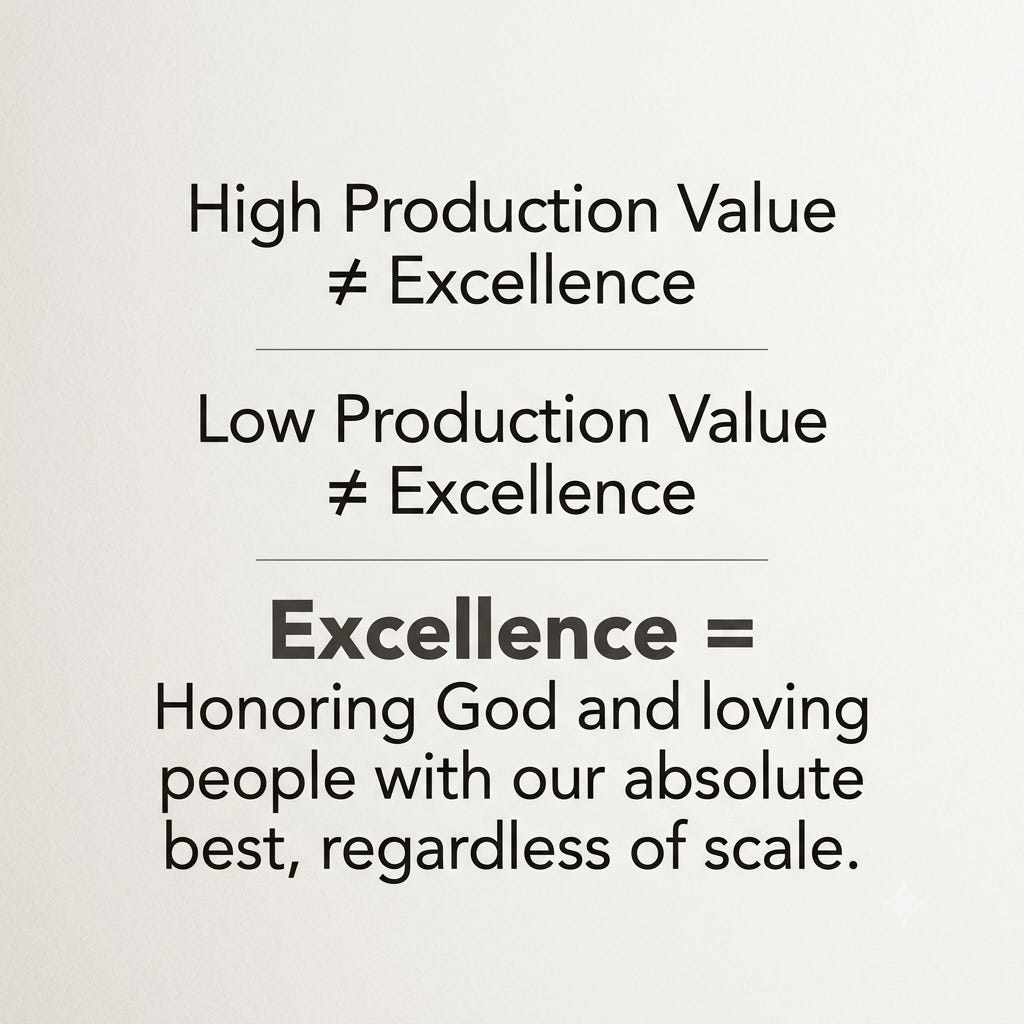
Now I want to land on my thesis, which I hope will be more challenging and thought-provoking: embracing simplicity must never become an excuse for sacrificing excellence.
Scripture repeatedly commands believers to work with diligence and care at everything we do for the ultimate purpose of pleasing the Lord (Colossians 3:23). The Psalms are replete with calls to apply genuine effort, skill, and reverence when worshipping God (Psalm 33:3). In the Old Testament, God sharply rebuked Israel for offering up blind, lame, and deformed animals as sacrifices while withholding their best (Malachi 1:8).
As New Covenant believers, we are no longer managing temple festivals or slaughtering livestock. But the moral and spiritual principle remains unchanged: giving God our absolute best, and bringing intentionality to our gatherings and times of fellowship, still applies.
This is something I suspect many in the house church world need to hear. Our strong convictions—mixed with a reactionary spirit against institutional excess—can make us quick to scoff at slick branding, expensive buildings, and professional church productions.
Our critique is often valid. The promotional cart demonstrably pulls the spiritual horse across much of the Western church, resulting in consumer accommodation, disordered priorities, and a lack of lasting fruit in disciple-making.
But the besetting sins of other church models do not give us a license for spiritual or operational laziness.
Too often, “simplicity” can become a spiritual-sounding cover for a lack of preparation, casual neglect, and general sloppiness. If we are not careful, our reaction to attractional consumerism could lead us straight into apathy, ineffectiveness, and even dishonor to God.
Here are three key areas where house churches must intentionally cultivate excellence.
1. Excellence in Hospitality
Building a laid-back, informal atmosphere to help unchurched neighbors feel welcome is good—but informal should never mean disorganized or careless.
I’ve attended house church gatherings where it was clear that virtually zero thought or effort went into hosting. Unwashed dishes piled in the sink, clutter everywhere, no clear seating arrangement, no music on, and a lack of snacks or any kind food laid out. I even showed up once to a house where ten minutes before the meeting was supposed to begin all the lights were off and the guys who lived there will still in their bedrooms!
What does it communicate about the worthiness of Jesus and the value of His people when physical neglect disrupts real fellowship? If we’ve accepted the sacred task of gathering God’s people, then it should be a matter of joy and faithfulness to prepare our spaces for spiritual connection.
People are far less likely to linger or open up in spaces where they feel uncomfortable or uncared for. Therefore, we ought to be thoughtful regarding environmental details: seating layout, temperature, lighting, background music, and overall cleanliness.
Yes, people are immeasurably more important than physical spaces. But the places we gather still matter because places affect people.
Hospitality, however, goes far beyond curating the environment (in fact, this can even be taken too far. See the story of Mary and Martha. At some point, the dishes are clean enough. It’s time to focus on Jesus). Hospitality is also displayed in how we love each other when we assemble. If members consistently show up late, distracted, disengaged, and unprepared to contribute, serve, or build up the body—are our gatherings truly an act of worship?
Enthusiastic welcome, warm presence, and tangible love should be the unmistakable trademarks of Christians gathered (John 13:35). We offer this intentional care to one another—and to the strangers God sends through our doors (because hey, they might be angels)—as a thank-offering to our Lord.
2. Excellence in Teaching
There is a concerning tendency to downplay the importance of teaching in some house and micro church circles. This usually stems from an overreaction to prevailing models that elevate the sermon (and the professional speaker) above all other spiritual gifts.
In scripture, however, leaders are explicitly commanded to work hard at preaching and teaching (1 Timothy 4:13, 1 Timothy 5:17), and we have to believe this instruction applies regardless of model. Handling the Word of God is never something we should casually dial in just because we are sitting on couches or around a coffee table. A key marker of an approved Christian worker is their ability to handle the word of truth with nuance and precision (2 Timothy 2:15).
House church teachers should strive to deliver biblically rigorous, culturally grounded, and spiritually convicting teachings. Furthermore, doing this well in a living room requires a more diverse set of skills than delivering a monologue from a stage: you must communicate God’s truth clearly while facilitating dynamic interaction, questions, and mutual contribution from the room. You also don’t have the benefit of a sound and lights team, or a back-up band to set the tone.
Striving for excellence doesn’t mean every teacher will be a world-class orator. There is a learning curve, and anything worth doing well requires practice, feedback, and occasional failure. But we must be humble and diligent enough to submit to that equipping process rather than settling for unprepared, stream-of-consciousness ramblings. The man who discipled me once quipped “going long is usually bad, but making God’s Living Word seem trivial or boring is unforgivable.” These are strong words, but worth taking to heart combined with a Spirit of humility and grace.
Additionally we believe in "every-member ministry” not “every-member teaching.” Public teaching is only a form of ministry. We all have different giftings and should major in areas of service to which the Spirit has suited us—while still being willing to try new things in faith. Those of us who don’t teach need not feel embarrassed about a lack of gifting or opportunity. Instead we should throw ourselves whole heartedly toward contributing to excellent house church meetings in other meaningful ways.
3. Excellence in Praise
When house church advocates talk about “worship,” conversation almost immediately turns to the notable absence of a worship band. We point out—rightly—that worship is a whole-life posture (Romans 12:1-2) and that God doesn’t need atmospheric lighting or fog machines to accept our adoration. Even the idea of having a dedicated time of singing uplifting, well-known songs as the lead-feature of corporate gatherings is a culturally conditioned phenomenon. This aspect of Christian community life has looked very different for churches throughout history, due to varied theological and cultural reasons.1
However, in stripping away the commercialized apparatus or Christian cultural norms of modern worship, house churches can sometimes fall into a different trap: we dilute praise until it becomes an afterthought.
Praise—biblically understood as corporate prayer, singing praise, thanksgiving, declaring God’s character, and exalting His glory—is one of the primary reasons the church exists (1 Peter 2:9). Yet, in some simple church contexts, praise, and prayer in general gets reduced to a couple minutes of awkward silence, or an unstructured session of prayer requests that involves much talking but little turning towards God.
I wrote more about the power and practice of authentic praise using Psalms 103-105 as a lens just a couple months ago. You can check it out at the link below.

In summary, excellence in praise doesn’t require musical sophistication—though that can be nice when gifted people are willing and available. But no matter what cultural form our worship takes, we still ought strive for authentic expression, theological depth, humble reflection, and whole hearted devotion.
What does excellence in praise look like in a living room?
Scripture-Saturated Adoration: It could looks like opening the Psalms and declaring the attributes of God aloud together with joy and reverence (Psalm 100).
Kingdom-Focused Prayer: It looks like moving beyond personal comfort requests to pray with spiritual authority, faith, and believing focus for your neighborhood, lost friends, and the global church (Acts 4:24-30).
Sacrifice of Thanksgiving: It looks like creating space for members to actively testify to God’s faithfulness, offering a “sacrifice of praise—the fruit of lips that openly profess his name” (Hebrews 13:15).
Wholehearted Participation: It looks like bringing our actual best to God in prayer and worship, rejecting passive spiritual postures.
Praise is giving glory to the of God and Savior. Whether that happens through singing, Scripture readings, guided intercession, or focused times of corporate thanksgiving, we ought to give it our full spiritual energy and focus.
Elevating the Standard
Simplicity ought to be about focus—stripping away institutional clutter so that the essential work of disciple-making, transformative community, and mission can flourish.
Excellence is about devotion—bringing our absolute best to those few, essential things because we serve a Lord who gave His best (and even himself) for us.
Let us guard against building complex machines that replace organic community with programmatic noise, and cater to consumerism. But let us be equally vigilant to guard against disorganization and apathy in our own ministry.
God is infinitely worthy. Let’s build house church communities that are beautifully simple, and undeniably excellent in what they’ve been formed to do.
3rd and 4th Century Christians only sang Old Testament Psalms, in order to resist Arian heresy which was often transmitted through popular songs. The Swiss Reformation under Zwingli removed music for the sake of emphasizing personal piety, and creating space to focus on God’s Word while shaking off the restrictions of Catholic liturgy. The underground church in Soviet Era Russia avoided singing to keep their meeting secret and deal with persecution. Some Western simple church movements encourage singing, but choose not centralize it at corporate gatherings where it might be alienating to guests.
Really helpful thoughts here Josh. Appreciate your challenge to keep the bar raised in the areas of hospitality, teaching, and praise. And to be aware of the pull towards mediocrity in some regards. More to explore here. Looking forward to anything more you have to share on this in future posts.